
The Hybrid booster is basically an attempt at trying to provide thrust using the oxygen available in the air for combustion. So far, there have been plans to use two separate stages with their own engines for lift off. As in, the first stage would have scram-jet engines and the second stage would have either a semi-cryogenic or fully cryogenic engine. The plans that I am aware of are to be applied for horizontal launches. However, what’s stopping us from putting the two stages into one? It would allow for a versatile engine and a possible vertical launch. Not only that, recovering two separate stages is harder, so single stage would make things much easier. Of course, this won’t exactly be an SSTO (Single-Stage-To-Orbit) but part of a two stage launch system.
Overview
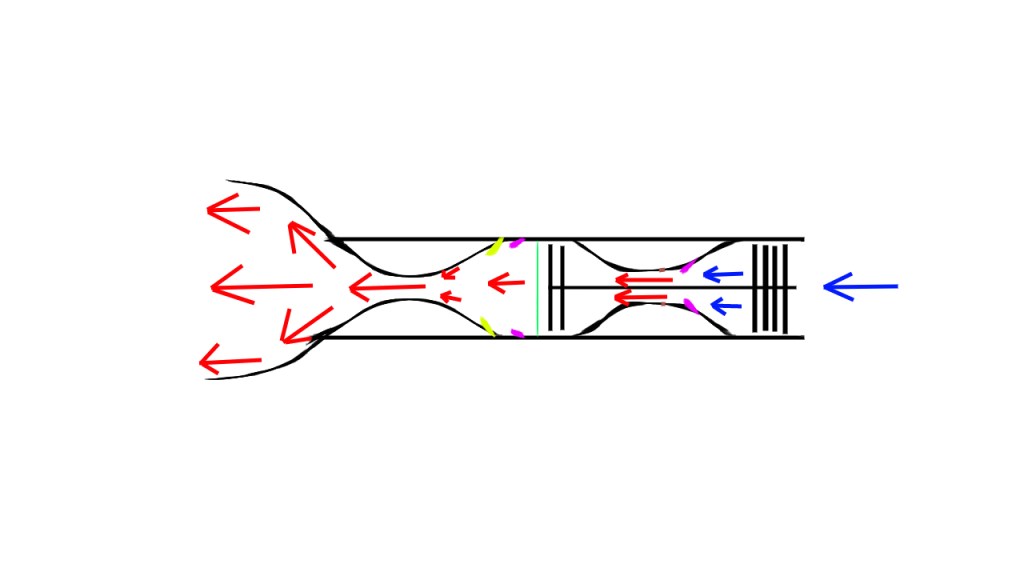
Basically, air goes in from the top (right side in image), gets compressed by the compressors (the four black turbines at the front) and has liquid methane injected into the stream. Igniters will ignite the air-fuel mixture and create a high pressure gas. The pressurized gas, with the inertia it already has, will be forced into the turbines which drive the compressors. The remaining energy of the gas will be forced down into the nozzle, providing thrust. What forces it, you ask? The compressors. The compressors will maintain a high pressure at the top where the force of the flow will be equal to flying at Mach 4. The compressors get their power from the turbines, the gas driving it due to it’s high velocity state which came from the high increase in temperature from combustion and “choking”. Choking is when the engine exhaust is forced down a small cross-sectional area, making it increase velocity. After the exhaust reaches Mach 1, it undergoes particle rearrangement, turning it into a sonic flow. After that, the nozzle will “catch” this flow as it turns supersonic until the pressure is too low to provide thrust. Speaking of which, I will need to make changes to the engine to ensure the “jet” exhaust doesn’t re-compress into a subsonic flow when entering the aft “rocket” combustion section. I am still rather new to the advanced physics behind the scenes. But I’m learning.
Scematics
Unfortunately, there is still a long way to go to actually declare any proper designs with measurements and modelling. However, the rough idea seems promising. I am currently learning the mathematical side of things in terms of engine mechanics. But it shouldn’t hinder me from speculating about the actual design.
So far, I think an octo-web structure would work best, like a falcon 9 booster. However, the fuel tanks are fully cryogenic with liquid methane as fuel and liquid oxygen as oxidiser. Nine Hybrid Engines in total per block. While it my look like I’m just taking it from Space-X, it is the best booster structure due to the lower thrust capabilities of the engines. Nine should suffice. Two blocks should hopefully be enough to get the CCSS off the ground with enough acceleration.
Coolant System
I’m not sure if a cooling system is required or not but I have taken a little inspiration for designing one anyway in case it is required. If you have looked at a piston engined aircraft, they sometimes have oil cooling systems where oil is pumped around the engine and then through an external radiator, usually underneath the engine. I think having radially built cooling systems would help in maintaining optimal temperature, hopefully increasing the service time of one Hybrid Booster block. Also, as a back-up, I’m thinking about implementing a last effort cooling in case of total engine integrity failure due to high temperature. Reservoir dump, all the coolant will get ejected directly into the engine intake to directly cool it and allow for a few more seconds of burning. Once the pipes and tanks are empty, the booster block will have to be ditched. Of course, it can still be recovered. But it may not be used again due to the extreme temperature stress.
Compressor G-Force
The compressors will need to be spinning at extreme velocities to be able keep the air pressure at the equivalent velocity of Mach 4 to allow enough compulsion pressure. Problem is that the compressors will need to be able sustain high rotational G force without damage. I’m guessing that 18,000 RPM will be the maximum number. Any higher and the compressors risk tearing apart. If I reduce the engine combustion to lower turbine and compressor power to reduce the compressor rotational velocity, there won’t be enough thrust. So I have an idea. Use electromagnetism to provide negative rotational force to the compressors. Of course, not directly but maybe via turbine shaft extensions that can be forced independently from the rest of the engine. The extensions will be directly slowing down the rotation like a brake disc on a car. Maybe.
 20,000 Words